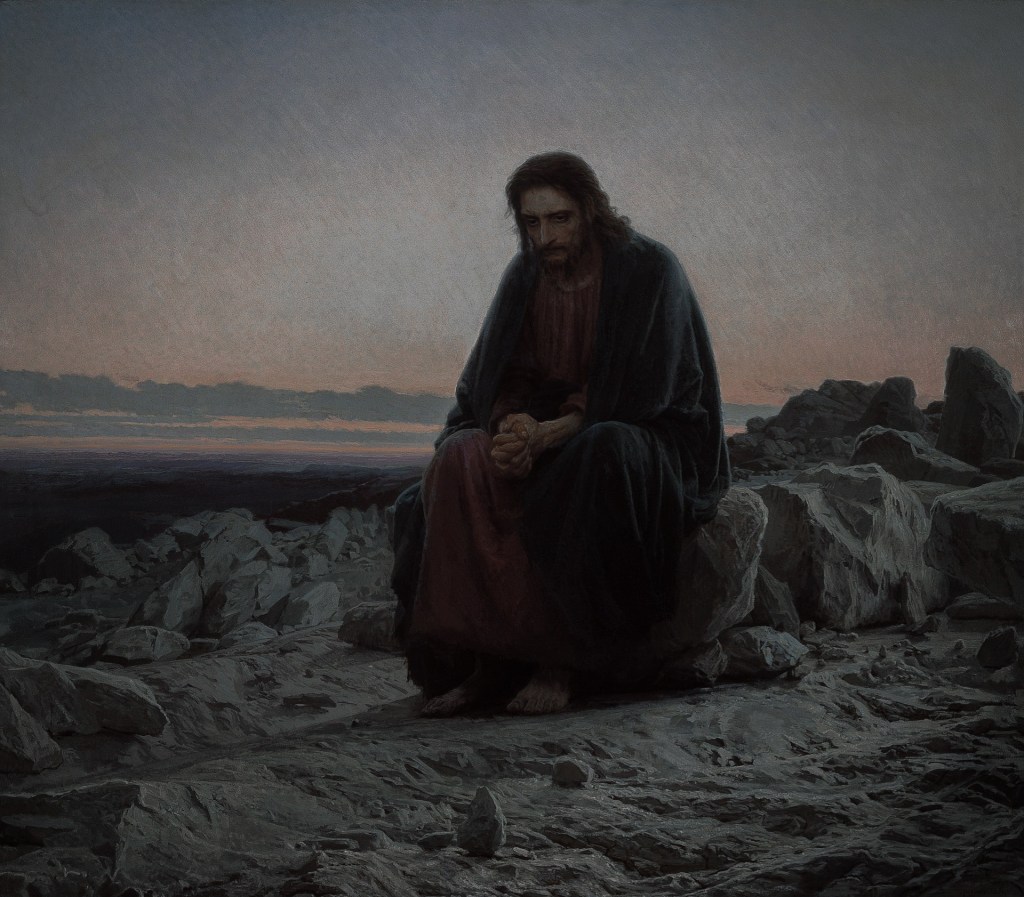
In 1938 the Catholic esotericist Valentin Tomberg gave a series of seven lectures on inner development, his fifth lecture being on Christ’s temptations in the wilderness.
The devil’s three temptations in reverse order of Matthew’s Gospel account are as follows:
1. The world and its glories, if he worships him
2. Testing God by jumping from the temple’s pinnacle
3. To turn stone to bread
From these three temptations we can compare our own inner constitutions and also examine the state of our overall modern intellectual and cultural life in regard to religion, art, and science.

Religion
In religion, regardless of which, we can see that it too often is reduced and brought down to concrete matters, partisanship and politicizing, a kingdom of ‘this world’ and its prince. When it turns to itself it tends at worst to a strict literalism or at best to a mere kind of psychological allegory.
Further, the tendency towards this temptation is also shown when our inclination begins to turn towards singular systems and individual personalities. So long as we remain loyal to their center point, then worldly glories and even utopias are possible, so they say. We see over and again how that goes. Tomberg having lived and given his lectures during the heyday of the Age of Ideology, whose systems to this day still haunt modern discourse, would’ve been particularly sensitive to this.
Art
In art, we encounter what leaves those who spiritually strive feeling unfulfilled. Artistic creations tending to dive down ‘from the precipice’ into the depths of the subconscious, into instincts, impulses, urges. Less to do with art, the temptation manifests itself in the ever increasing chase for experiences, increasing ‘highs’ and experimentation. Our minds having closed to what is above, we’ve opened what is below and seek inspiration and even ‘revelation’ in this murky sphere.
Science
In science, we succumb to the concept that the world can be foundational to everything, that ‘everything living is only a consequence of movement in this mechanical, dead world. That is to say, all bread arises out of stone.’ This is to set our sights backwards, to begin with matter’s primacy rather than things above. We could say further that an over concern with turning ‘stones to bread’ reflects an obsession with looking for earthly ‘solutions’ to everything, to the point of believing it can spiritually elevate us, or cut corners. I can only wonder what Tomberg would have to say if he observed some of our behavior with AI, or supposedly uploading our consciousness to a computer.
“Man does not live by bread alone,” this life comes from above rather than from below.
If one is to rid themself of these temptations we ought to:
1. Will ‘cleansed of desire for power’
2. Feel ‘free from chance’ (impulse, external influence, etc)
3. Think ‘free of the body’
The three passions which Christ underwent that one must exemplify within in order to achieve this are:
1. The washing of feet
2. The scourging
3. The crowning with thorns